
On a rather chilly day, eight of us found our way to the ancient church of St. Cuthbert, Cliburn, on the edge of the village, shrouded by trees. Parts of it date back to the 12th century, although the south aisle in which the organ stands was added in 1887. The organ, which was built by Wilkinson & Sons of Kendal in 1894, has a handsome appearance, with spotted metal front pipes and an attractive wooden case. An unusual feature of the console is that the drawstops on each side are concealed in little cupboards with hinged doors. On the left there are three Swell stops, all of 8 foot, a Violin Diapason, Lieblich Gedact and Oboe, together with just two couplers – Swell to Great and Great to Pedal, but no Swell to Pedal. On the right there are the Great Open Diapason, Dulciana 8’ and Harmonic Flute 4’, and the Pedal Sub Bass 16’. There is a balanced Swell pedal, but just two octaves of pedals, making their use somewhat hazardous for the uninitiated.

After an interesting journey via the villages of Bolton and Colby, we arrived in Appleby for a very pleasant lunch at the Crown and Cushion inn, where we were joined by Claire Oldfield, who had travelled by train from Yorkshire. The 17th century organ in St. Lawrence’s Church has a magnificent case and stands proudly at the west end of the nave, from where its sound carries beautifully to every part of the building. There are some delightful individual stops and a wide range of colours, from the expressive Swell strings to a bold Trumpet on the Great. The Pedal even boasts a 16’ Fagott. Over the years this organ has been moved and renovated several times, but is now due for further remedial work which it is hoped will prolong its life for many years to come, once the funds have been found.
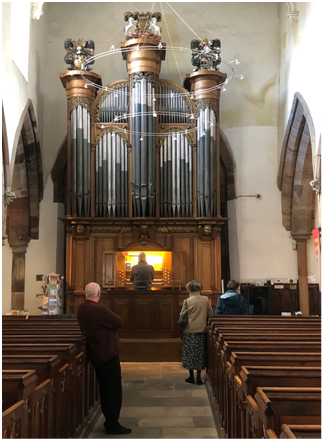
Our members did themselves credit in their performances of music by “old masters” such as Sweelinck, Boyce and J. S. Bach, the Prière à Notre-Dame by Boëllman, and contemporary pieces by Christopher Tambling and others.
National Pipe Organ Register Links